
Buying Property in Sicily: The Complete Guide for Foreign Buyers
Buying property in Sicily can be one of the most rewarding ways to create a life in Italy.
For some buyers, it means a small home in a historic hill town. For others, it means a coastal apartment, a countryside villa, a renovation project, or an investment property for holiday rentals.
Sicily still offers price points that are difficult to find in much of Europe. But an affordable asking price does not automatically mean an affordable purchase.
The key is understanding the full picture before you commit:
- Where to buy
- What type of property suits your plans
- The real cost beyond the listing price
- How offers and contracts work in Italy
- What a notary, surveyor and lawyer each do
- How to avoid expensive mistakes
Important: Affordable Sicily is not a real estate agency, law firm or tax adviser. Every property, contract, tax position and renovation project should be independently checked by qualified professionals before you buy.
Can Foreigners Buy Property in Sicily?
In most cases, yes.
EU citizens can generally buy property in Italy under the same rules as Italian citizens. For non-EU buyers, the position can depend on nationality, residency status and the principle of reciprocity between Italy and the buyer’s home country.
A notary will normally confirm whether a non-EU buyer can proceed and which documents are required. Do this early, especially if you are buying from outside Italy or planning to purchase through a company.
Buying a property in Sicily does not automatically give you residency rights or a visa. Property ownership and immigration status are separate matters.
Why Buy Property in Sicily?
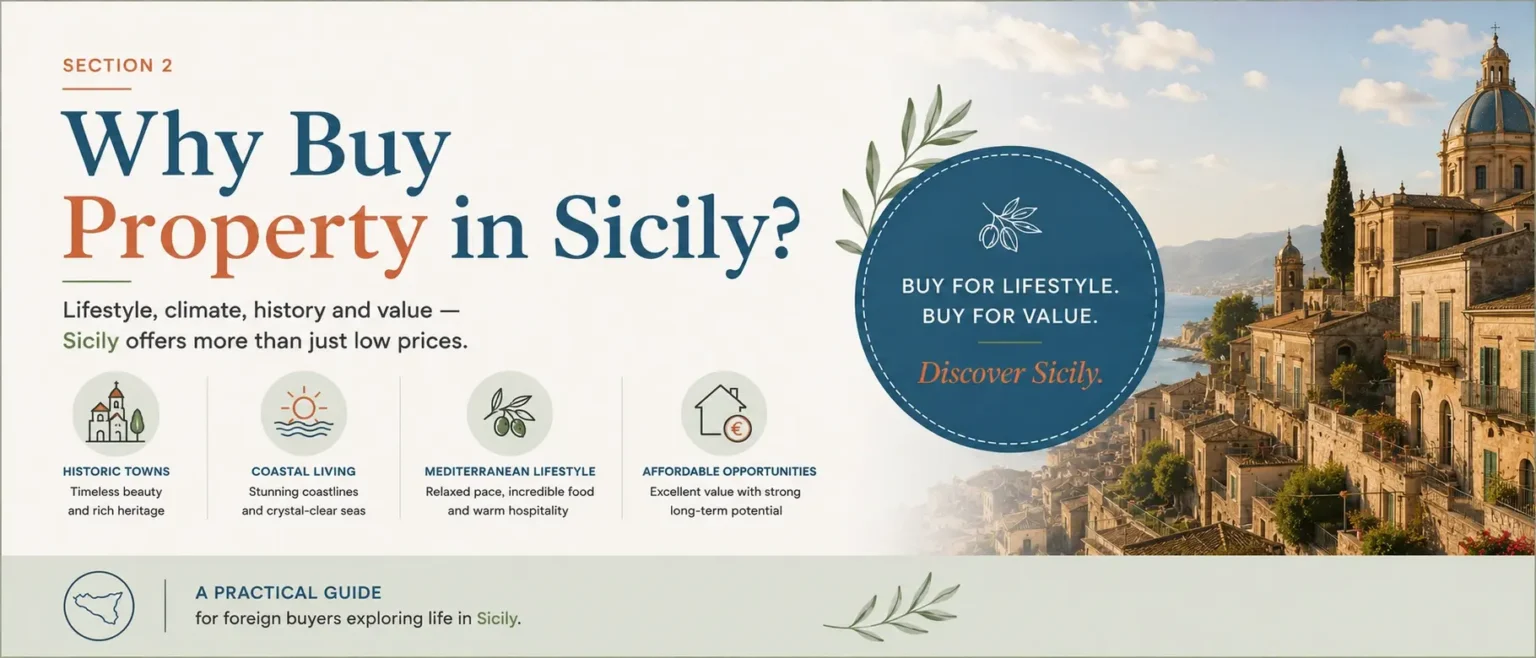
Sicily attracts buyers for more than low prices.
It offers a rare combination of historic towns, Mediterranean climate, local food culture, beaches, mountains, UNESCO cities and a slower everyday rhythm. The island has very different lifestyles depending on where you buy.
You might choose:
- A Baroque home in Ragusa, Modica or Noto
- A traditional stone house in an inland town such as Mussomeli, Troina or Gangi
- A sea-view apartment near the coast
- A countryside farmhouse with land
- A move-in-ready home for retirement or remote work
- A renovation project with long-term lifestyle or rental potential
The best location is not necessarily the cheapest town. It is the place that fits your actual plan.
Ask yourself:
- Will this be a holiday home, full-time residence, rental investment or mixed-use property?
- Will you need airports, hospitals, schools, supermarkets or reliable year-round services nearby?
- Are you comfortable with a remote inland location?
- Will you visit often during the renovation?
- Do you need a town that remains active outside the summer season?
The First Rule: Budget for the Entire Project, Not Just the House
The listing price is only one line in your budget.
A €20,000 property can be an excellent purchase. It can also become a €120,000 project once taxes, fees, repairs, utilities, furniture and unexpected structural work are included.
Your total budget should include:
- Purchase price
- Registration tax or VAT, depending on the transaction
- Notary fees
- Estate agency commission
- Surveyor, architect, engineer or legal fees where needed
- Translation and document costs
- Mortgage costs, if applicable
- Renovation and furnishing
- Utility connections or upgrades
- Travel, accommodation and time on the ground
- A contingency fund for unexpected work
For a practical step-by-step budget framework, read our First-Time Buyer Checklist.
For renovation properties, do not estimate costs from photos alone. Read our Real Renovation Costs in Sicily guide before making an offer.How Much Does It Cost to Buy Property in Sicily?
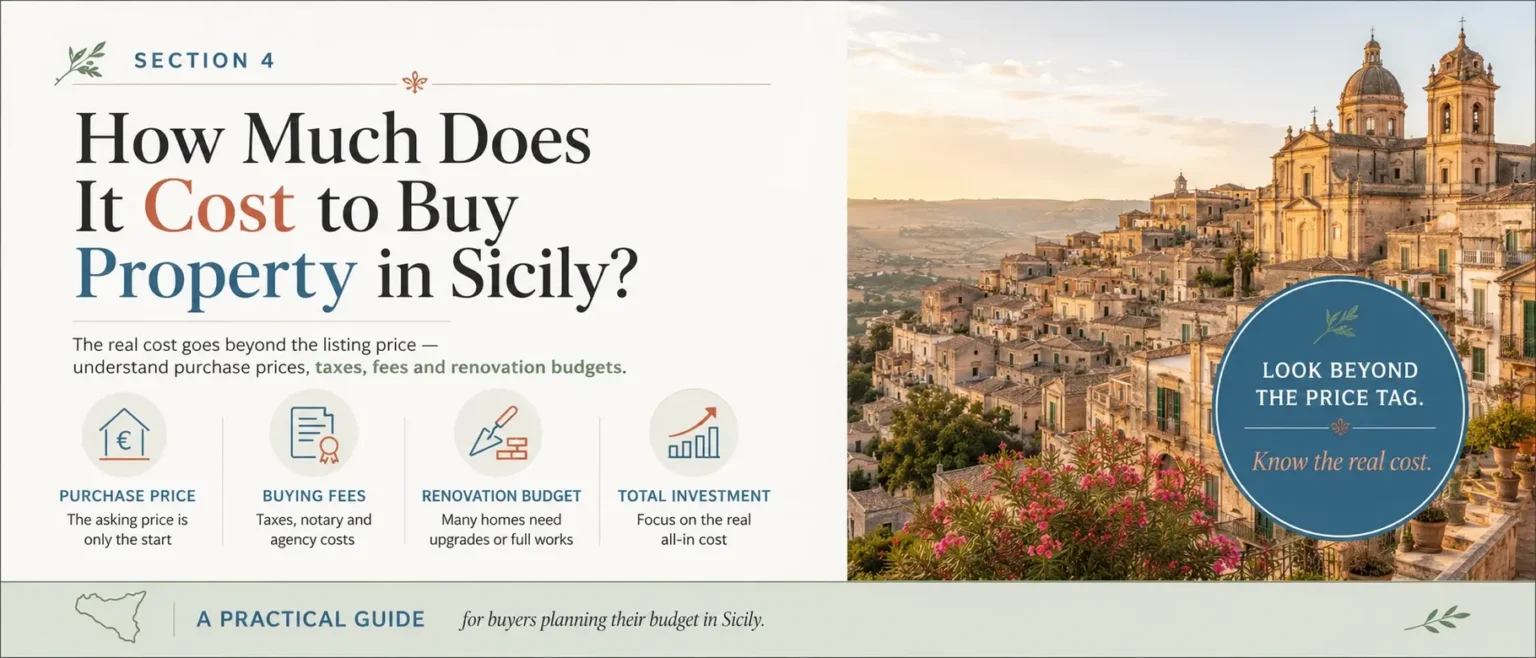
There is no single answer because Sicily has several very different markets.
A small house in an inland village can cost less than a city parking space. A restored historic apartment in a sought-after Baroque town can cost far more. Coastal locations, tourist hotspots, properties with outdoor space and move-in-ready homes usually command stronger prices.
As a general rule:
| Property type | Typical budget reality |
|---|---|
| €1 home or distressed property | Very low purchase price, potentially high renovation commitment |
| Small inland renovation property | Low entry price, but requires technical checks and a realistic works budget |
| Move-in-ready village home | Higher purchase price, lower immediate renovation exposure |
| Coastal apartment | Often higher price per square metre, stronger lifestyle and rental demand |
| Countryside villa or farmhouse | May require more infrastructure, access, land and maintenance planning |
| Historic city property | Can involve planning constraints, premium restoration work and stronger demand |
The right question is not “What is the cheapest property in Sicily?”
It is:
“What property gives me the best outcome within my total budget, timeline and lifestyle plan?”
Choose the Right Area of Sicily
Sicily is not one market.
The island is large, geographically varied and shaped by local economies, transport links, climate and tourism. A home in a quiet inland town offers a completely different experience from an apartment in Catania, a coastal property near Cefalù or a Baroque home in south-eastern Sicily.
Inland towns
Inland towns can offer some of the lowest purchase prices and the strongest sense of local community.
They may be suitable for buyers who value authenticity, space, historic architecture and slower living. However, they can involve longer drives to airports, beaches, hospitals or major shopping areas.
Consider inland towns if you want:
- Traditional town houses
- Historic centres
- Lower purchase prices
- Cooler temperatures at higher elevations
- A quieter, more local lifestyle
Coastal towns and villages
Coastal areas offer beaches, tourism demand and a more seasonal lifestyle.
They can be attractive for holiday homes and short-term rental strategies, but prices can be higher and winter life can be quieter in some resort locations.
Consider coastal areas if you want:
- Sea access
- Holiday use
- Potential tourism demand
- Outdoor living
- Stronger international appeal
Cities and larger towns
Cities such as Palermo, Catania, Syracuse, Ragusa and Trapani offer more services, transport links, restaurants, healthcare and year-round activity.
They can be a better match for buyers who plan to live in Sicily full time, work remotely, study, or rely on public transport.
Countryside and rural properties
A farmhouse or villa can offer privacy, land and dramatic views.
But rural properties require extra due diligence. Check road access, boundaries, water supply, septic systems, planning status, utility capacity, wildfire exposure and maintenance obligations before becoming emotionally attached to the view.Choose the Right Type of Property
The property type determines much of your future cost, workload and risk.
Renovation projects
Renovation properties can offer character, lower purchase prices and the chance to create something personal.
They are best for buyers with patience, a strong contingency budget and the ability to manage decisions from abroad or spend time in Sicily.
Before buying, check:
- Roof condition
- Structural movement or cracking
- Damp and drainage
- Plumbing and electrical systems
- Sewer or septic arrangements
- Windows and insulation
- Planning history
- Access for contractors and materials
- Whether the existing layout can legally be changed
Read our detailed Real Renovation Costs in Sicily guide for real examples of what low-cost purchases can actually become.
Move-in-ready homes
Move-in-ready does not mean maintenance-free.
A property may look finished but still need electrical upgrades, better heating, air conditioning, insulation, waterproofing or new windows.
This type is often the best choice for buyers who want to use the home immediately and renovate gradually.
Apartments
Apartments can be easier to maintain than detached homes, especially for overseas buyers.
But always check condominium costs, shared roof obligations, building rules, unpaid charges, lift maintenance, common areas and whether short-term rentals are permitted under building rules and local requirements.
Villas and countryside homes
Villas can offer space, privacy and land, but they often come with more infrastructure.
A lower purchase price can be offset by road repairs, retaining walls, drainage, water storage, septic systems, fencing, land management and higher maintenance.Before You Make an Offer: What to Check
This is the stage where careful buyers save money.
Do not rely only on online listings, photographs, verbal assurances or a seller’s description. Ask for documents and have the property checked by professionals who work for you.
Your due-diligence checklist should include:
1. Ownership and title
Confirm who owns the property and whether all owners are participating in the sale.
Inherited homes, family-owned properties and older buildings can sometimes involve multiple heirs or unresolved ownership issues.
2. Cadastral records
The cadastral plan should match the property you are buying.
Check the recorded layout, floor area, boundaries, storage rooms, terraces, balconies and any land included in the sale.
3. Planning and building compliance
A property can exist physically while still having planning irregularities.
Ask whether the building matches approved plans and whether previous alterations were properly authorised. This is especially important for extensions, terraces, loft conversions, rural buildings and historic properties.
4. Mortgage, liens and legal restrictions
A notary performs important legal checks before completion, but identify potential issues as early as possible.
Ask whether there are mortgages, charges, rights of way, legal disputes, access rights, tenant claims or other restrictions affecting the property.
5. Structural and technical condition
For older or distressed homes, appoint a qualified surveyor, architect or engineer before committing to a binding contract.
A technical inspection may reveal issues that photographs cannot show:
- Roof failure
- Structural cracks
- Foundation movement
- Water damage
- Failing retaining walls
- Unsafe electrical systems
- Missing drainage
- Illegal internal changes
6. Utilities and access
Confirm whether water, electricity, internet, gas and sewerage are connected, usable and correctly registered.
For rural property, confirm practical vehicle access, road ownership, water rights, septic arrangements and the cost of bringing utilities up to modern standard.Making an Offer in Sicily
Once you find a property you want, the next step is usually a written offer: the proposta d’acquisto.
The offer normally states:
- Buyer and seller details
- Property identification
- Offered price
- Deposit terms
- Expiry date for acceptance
- Conditions, where applicable
- Proposed completion timeline
Once accepted, an offer can create meaningful obligations. Do not treat it as a casual expression of interest.
Before signing, make sure you understand:
- What deposit you are paying
- Whether it is refundable and under which conditions
- What happens if the seller refuses or cannot complete
- Whether the offer is conditional on finance, technical checks or document verification
- Whether an agency commission becomes due
- What happens if a legal or planning problem emerges
The Preliminary Contract: Compromesso
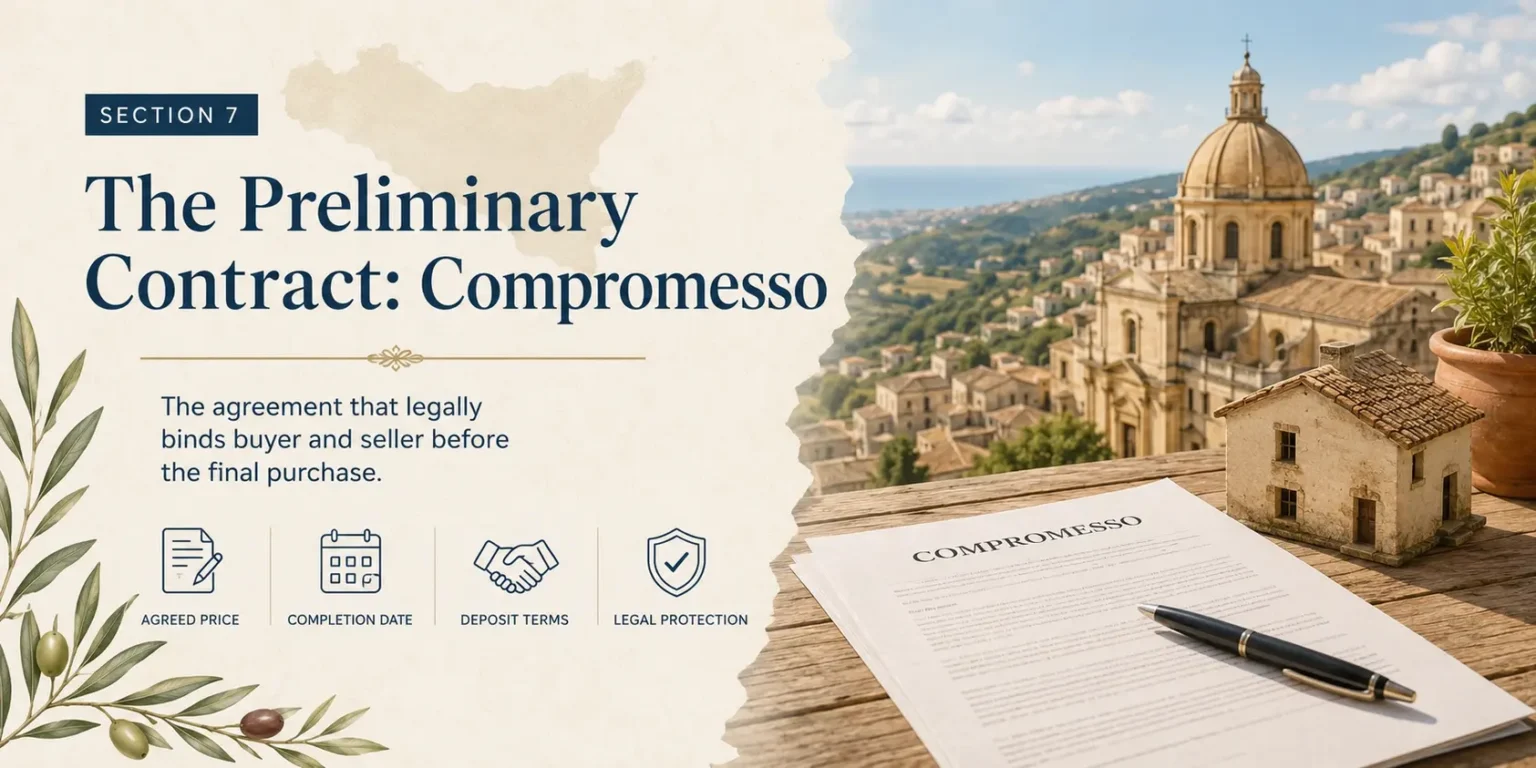
Once you find a property you want, the next step is usually a written offer: the proposta d’acquisto.
The offer normally states:
- Buyer and seller details
- Property identification
- Offered price
- Deposit terms
- Expiry date for acceptance
- Conditions, where applicable
- Proposed completion timeline
Once accepted, an offer can create meaningful obligations. Do not treat it as a casual expression of interest.
Before signing, make sure you understand:
- What deposit you are paying
- Whether it is refundable and under which conditions
- What happens if the seller refuses or cannot complete
- Whether the offer is conditional on finance, technical checks or document verification
- Whether an agency commission becomes due
- What happens if a legal or planning problem emerges